Code is slowly getting replaced. Not fully. But the role of writing every line by hand is fading.
Humans are being pushed out of the tight execution loop. AI agents can already scaffold apps, write APIs, fix bugs, deploy infra, and monitor logs. What they still struggle with is deep context. Old decisions. Hidden trade-offs. That weird service someone wrote in 2016 that nobody fully understands, but everything depends on.
Integrations are hard because they require institutional memory. Why did we choose this vendor? Why is this flow async? Why does this edge case exist? AI can read the code, but it can’t feel the history behind it.
But as we advance, new projects will be optimized for AI first.
That means building systems with clean contracts, better documentation, and fewer dependencies on tribal knowledge that lives only in someone’s head. It means structured logs that machines can reliably parse, and clear API boundaries that make behavior predictable. In short, software has to be explicit, readable, and structured enough for agents to operate without guessing.
Software today is mostly built for humans to click and reason about. But increasingly, the primary “user” of software will be agents. And agents do not care about UI polish. They care about predictable systems. They care about structured inputs and outputs. APIs and CLIs are their native language.
Developers won’t need to know every internal detail. They will supervise systems. Keep them running. And delegate chunks of work to agents.
A dev might say, “Spin up a new auth microservice.” “Refactor this payment flow.” or “Run load tests and fix bottlenecks.” And the agent does 80%. Humans review and make judgment calls.
Execution becomes cheap. Judgment does not.
So what happens next?
1. AI chooses the tools
AI agents will start deciding what stack to use.
If agents repeatedly succeed with a certain framework, that framework gets reinforced. Tools that are easy for AI to reason about will win. Tools that are messy or poorly documented will fade.
Imagine:
- An agent consistently chooses clean SDKs over complex ones.
- Libraries optimized for machine-readability.
- Dev tools marketing not to humans, but to agents.
If you’re building in dev tools, you’ll optimize for:

AI becomes the primary “user.”
And when the user changes, the product strategy changes.
2. SaaS shrinks at the low end
Basic SaaS tools may struggle.
Why pay for a niche SaaS product if an internal AI system can build a lightweight version in a week?
Example:
- Instead of paying for a simple CRM, a company generates a custom internal one.
- Instead of using a no-code form builder, they generate one connected directly to their DB.
- Instead of subscribing to analytics SaaS, they generate dashboards over their warehouse.
Low-complexity SaaS becomes vulnerable.
If your product is mostly “a prompt + UI,” then as intelligence gets 100x better and cheaper, your moat approaches zero.
But deep integration SaaS survives. Anything that:
- Aggregates massive data across companies.
- Requires network effects.
- Depends on regulatory compliance.
- Or, requires capital-heavy infrastructure.
Those will still exist.
The key question becomes: how much software and system is required around the intelligence to make it valuable? If the answer is “a lot,” there is defensibility. If the answer is “almost nothing,” you are fragile.
3. In-house infra increases
More companies will build internal AI layers. Not just chatbots. Full execution systems.
Imagine:
- A sales agent who writes outreach emails and books meetings.
- A finance agent who reconciles transactions and flags anomalies.
- A product agent that reads user feedback and proposes roadmap items.
Instead of buying five SaaS tools, companies build one internal AI system connected to everything.
Agents will need identities. Permissions. Memory. Audit trails. Safe ways to execute code. Controlled ways to spend money. Oversight layers. These are new infrastructure categories.
The cost of building drops. So the default becomes: build it ourselves.
But the complexity shifts from writing code to orchestrating systems safely.
4. The bar for products rises
Earlier, building a mental health app required:
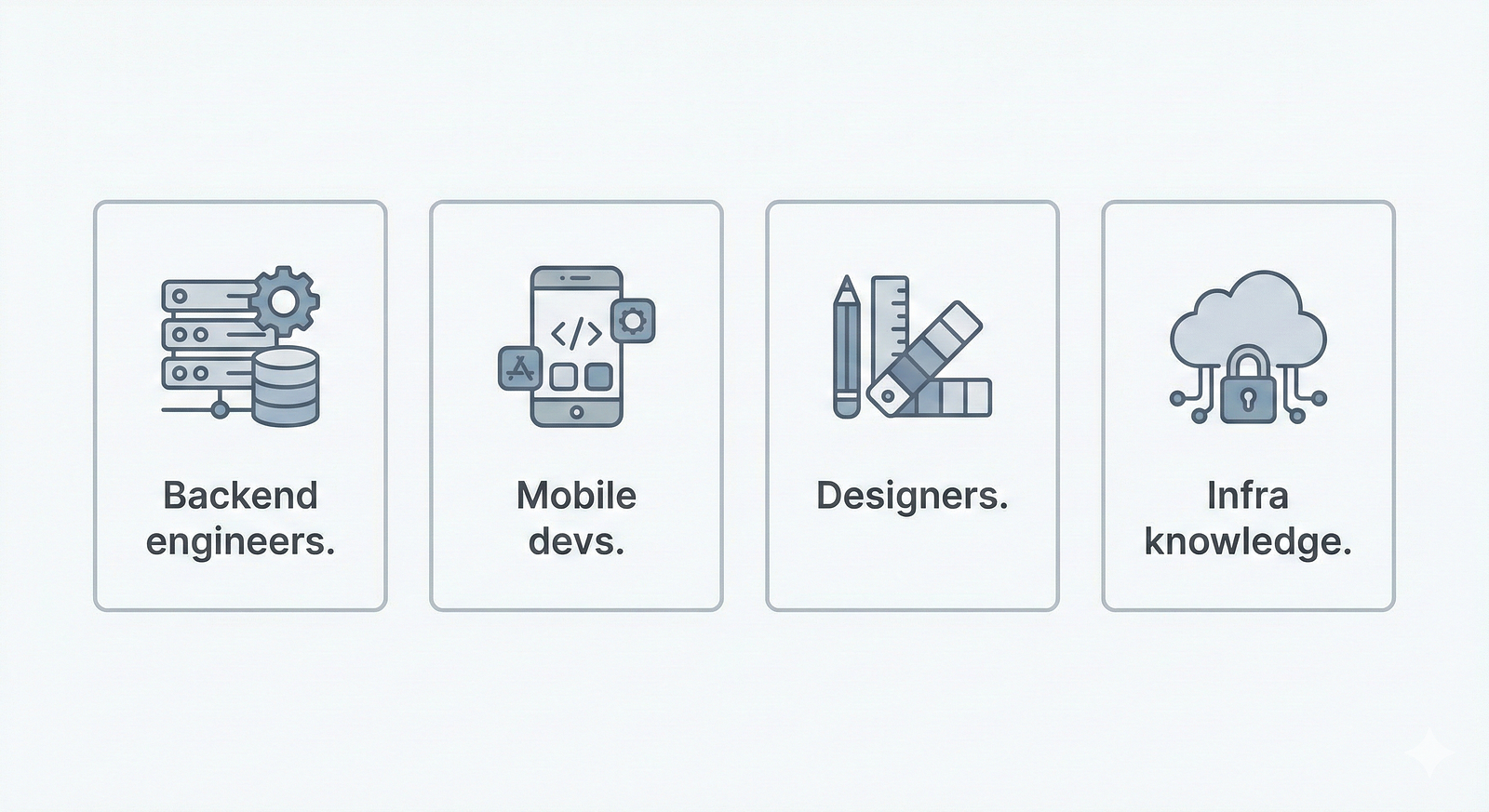
Now, a small team can generate most of it.
So what changes?
Distribution becomes harder.
Trust becomes harder.
Differentiation becomes harder.
Technology has never really been the moat. And with AI coding models, it becomes even less so. Cloning interfaces and reproducing features is easier than ever.
The technical moat shrinks. The system moat grows.
5. Developers wear more hats
If execution is automated, developers move up the stack. Instead of spending most of their time implementing features, they spend more time talking to users, defining the real problem, shaping product direction, designing flows, thinking about growth, and deciding trade-offs.
The focus shifts away from “how do I implement this?” and toward “should this exist at all?” It becomes less about typing and more about judgment. Developers move from builders of code to designers of systems that supervise intelligence.
This is uncomfortable.
Because it removes the comfort zone of pure implementation. But it also brings us closer to why many got into this field in the first place: to build meaningful products.
6. AI-native tools emerge
New tools will be designed assuming:
- Code is written by agents.
- APIs are consumed by machines.
- Decisions are automated.
Example:
- Observability tools that explain issues in structured formats.
- Deployment systems that expose self-healing hooks.
- SDKs that embed best practices automatically.
These tools will not just look good in dashboards. They will be optimized for machine consumption.
If agents are doing the work, your product must be usable by agents.
7. Capital dynamics shift
Right now, training frontier models requires massive capital. So most developers depend on large providers.
But if:
- Open-source models improve.
- Hardware gets cheaper.
- Specialized small models become strong.
Then, smaller companies can own more of their stack.
The “build vs buy” line keeps moving. And as intelligence gets cheaper, the differentiator becomes less about raw capability and more about how intelligently it is integrated.
In the end, the anxiety around AI is understandable. Many people still think the models are not good enough because they only see public demos, not production systems being used seriously inside companies.
But once you’ve worked closely with the latest models, it’s clear they are already capable of meaningful work.
The real fear comes from something deeper: when execution becomes cheap, the identity of being “the one who knows how to code it” starts to fade. Yet this is less about replacement and more about elevation.
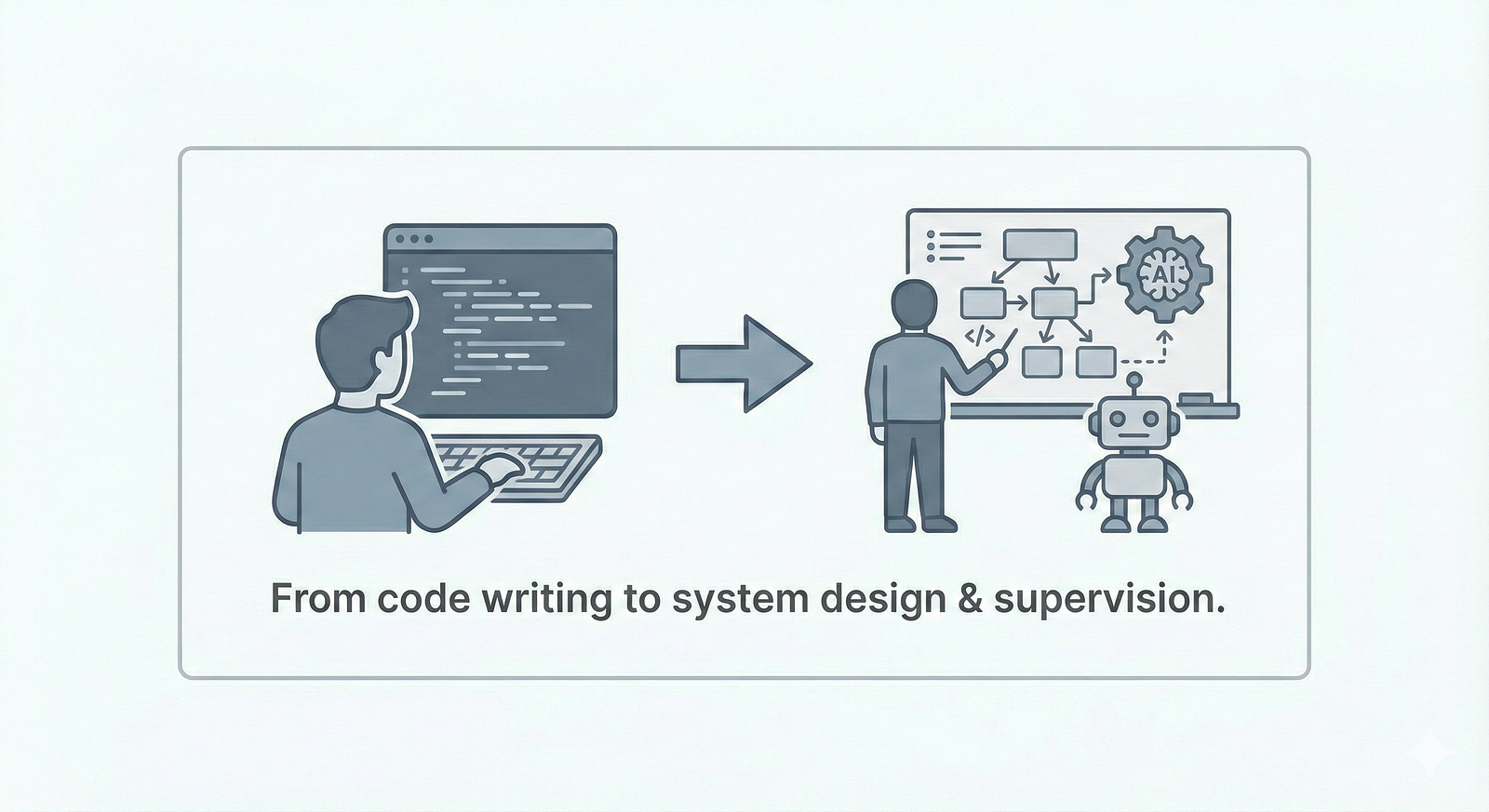
We are moving from a world where software is built mainly for humans to one where it is increasingly built for agents acting on behalf of humans. The loop expands, execution gets delegated, and leverage moves up the stack. And that may allow us to focus more on solving real problems, which is why many of us entered this field in the first place. The real question is not whether AI replaces developers, but what kind of developer remains valuable when execution becomes cheap.
Leave a Reply